What is DevOps?
DevOps is a business-driven approach that helps organizations deliver software faster, improve reliability, and scale efficiently by aligning development and IT operations.
For businesses undergoing digital transformation, DevOps becomes significantly more effective when supported by scalable infrastructure like cloud solutions, enabling faster deployments and operational flexibility
Leading cloud providers have standardized DevOps practices at scale. Platforms such as AWS DevOps services and Microsoft Azure DevOps solutions offer built-in tools for automation, continuous integration, and monitoring—making it easier for businesses to adopt DevOps efficiently.
Why DevOps is Critical for Business Growth
In today’s market, businesses compete on speed, customer experience, and continuous innovation.
Organizations that rely on traditional development models often struggle with:
- Slow release cycles that delay product innovation and market response
- Frequent system issues that negatively impact customer experience
- High operational costs due to manual processes and inefficiencies
DevOps changes this dynamic completely.
- Faster delivery cycles allow businesses to launch features quickly and stay ahead of competitors, especially in fast-moving industries
- Continuous monitoring and feedback loops help identify and resolve issues before they impact users, improving reliability
- Automation reduces operational overhead and increases team productivity, enabling efficient scaling
Companies that adopt DevOps—especially with expert-led DevOps consulting services - consistently achieve faster releases, improved system stability, and better business outcomes.
How DevOps Works
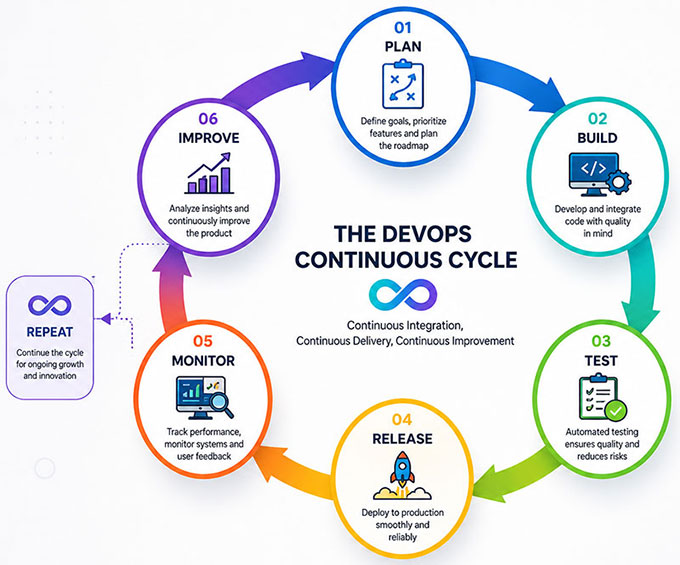
DevOps follows a continuous cycle:
What This Means for Your Business
| Stage | Business Perspective | Strategic Impact |
|---|---|---|
| Plan | Aligning features with customer needs and business goals |
Ensures focused investment |
| Build | Rapid development of new features |
Accelerates innovation |
| Test | Continuous quality validation |
Reduces risks and failures |
| Release | Frequent launches |
Keeps offerings competitive |
| Monitor | Real-time performance tracking |
Enables faster decisions |
| Improve | Continuous enhancements |
Drives growth |
Modern DevOps Practices in 2026
Modern DevOps is no longer limited to faster deployments. In 2026, businesses are adopting advanced DevOps practices to improve scalability, strengthen security, reduce operational risks, and accelerate digital transformation.
Organizations investing in DevOps consulting services are increasingly building cloud-ready delivery environments that support faster innovation and long-term business growth.
Continuous Delivery & Automation
Modern DevOps enables businesses to release updates continuously instead of relying on slow and infrequent deployments. Automation helps teams reduce manual effort, improve delivery speed, and respond to customer needs more efficiently.
Integrated Security with DevSecOps
Security is now embedded directly into development and deployment workflows rather than handled separately. This helps businesses identify vulnerabilities earlier, improve compliance readiness, and reduce operational risks.
Cloud-Native Scalability
Businesses are increasingly combining DevOps with cloud solutions services to build flexible and scalable infrastructure. This allows organizations to handle growth more efficiently while optimizing operational costs.
Real-Time Monitoring & Observability
Modern DevOps practices focus heavily on continuous monitoring and performance visibility. Real-time insights help businesses detect issues faster, minimize downtime, and improve customer experience.
AI-Powered Operations
AI is becoming an important part of DevOps by helping automate monitoring, predict system failures, and improve operational efficiency. Businesses adopting intelligent automation are building more resilient and scalable digital systems.
As businesses continue expanding their digital ecosystems, modern DevOps practices are becoming essential for delivering faster innovation, stronger reliability, and better customer experiences.
Key Business Benefits of DevOps
Faster Time-to-Market That Drives Revenue
- Businesses can release updates more frequently, enabling quicker response to market opportunities and customer needs
- Faster delivery cycles help validate ideas and improve products rapidly
Reliable Systems That Improve Customer Trust
- Continuous testing and monitoring ensure fewer failures and quicker recovery, minimizing disruption
- Stable systems lead to higher customer satisfaction and retention
Scalable Infrastructure That Supports Growth
- DevOps works seamlessly with cloud solutions, allowing businesses to scale resources based on demand
- This flexibility supports growth without major infrastructure changes
Better Team Alignment and Productivity
- Teams collaborate toward shared outcomes, reducing delays and improving execution
- Faster communication leads to quicker decision-making
Long-Term Cost Optimization
- Automation reduces manual effort, helping businesses lower operational costs and improve efficiency over time
- Early issue detection avoids expensive production failures
DevOps vs Traditional Development
| Business Factor | Traditional Approach | DevOps Approach |
|---|---|---|
| Speed of Delivery | Slow and release-based | Continuous and fast |
| Risk | High due to late testing | Lower due to continuous validation |
| Team Efficiency | Siloed teams | Collaborative teams |
| Customer Experience | Inconsistent | Reliable |
| Scalability | Complex and costly | Flexible and efficient |
Is Your Business Struggling with Slow Releases and Operational Bottlenecks?
Implement modern DevOps practices to accelerate deployments, improve scalability, reduce downtime, and streamline software delivery across your organization.
DevOps Use Cases by Industry
E-commerce
- Enables frequent feature updates such as payment integrations and UI improvements, helping businesses stay competitive
- Reduces downtime during high-traffic events
Fintech
- Supports secure and reliable deployments, which are critical for financial transactions
- Improves compliance and system performance
Healthcare
- Ensures high availability and data reliability, essential for patient care systems
- Enables faster deployment of digital health solutions
Startups & SaaS Companies
- Allows rapid experimentation and faster product iterations, helping achieve product-market fit
- Reduces time required to scale operations
DevOps ROI: What Businesses Actually Gain
For business leaders, DevOps is not just about process improvement—it’s about measurable returns.
| Metric | Before DevOps | After DevOps |
|---|---|---|
| Release Frequency | Weeks or months | Daily or multiple times per day |
| Time to Fix Issues | Hours to days | Minutes to hours |
| Deployment Success Rate | Lower | Significantly higher |
| Operational Costs | Higher due to inefficiencies | Optimized through automation |
👉 Faster releases lead to quicker revenue realization, while reduced downtime minimizes both direct losses and long-term reputational impact.
Businesses that leverage structured DevOps consulting services often accelerate ROI by avoiding common implementation pitfalls.
Real-World DevOps Example
A growing SaaS company was struggling with slow deployments, inconsistent release quality, and downtime during product updates. By implementing automated DevOps workflows, continuous monitoring, and cloud-based infrastructure, the company streamlined its software delivery process and improved operational efficiency.
Within 4 months:
- Deployment frequency increased from once every two weeks to multiple releases per week
- Deployment-related downtime was reduced by nearly 60%
- Issue resolution time improved by approximately 40% through real-time monitoring
- Development teams were able to deliver new features significantly faster with fewer manual dependencies
👉 This demonstrates how businesses adopting modern DevOps consulting services can improve delivery speed, reliability, and scalability while reducing operational bottlenecks.
How to Implement DevOps Successfully
Successful DevOps adoption requires a strategic and phased approach:
- Start by evaluating your current development and delivery workflows to identify inefficiencies and bottlenecks, ensuring a clear roadmap for transformation
- Encourage collaboration across development, operations, and business teams so everyone works toward shared outcomes, improving execution speed
- Introduce automation in testing and deployment gradually to reduce manual errors and increase efficiency, without overwhelming teams
- Leverage scalable infrastructure such as cloud platforms to support flexibility and growth, especially for modern applications
- Continuously monitor performance and refine processes based on real-time data, ensuring ongoing improvement
Common Challenges (and How to Solve Them)
- Organizations often face resistance to change when adopting DevOps, which can be addressed by clearly communicating business value and involving leadership early
- Skill gaps can slow down implementation, making it beneficial to upskill teams or partner with experienced professionals
- Tool complexity can become overwhelming, so starting with a minimal and scalable toolset is recommended
- Security concerns should be addressed by integrating security practices into every stage rather than treating them separately
👉 Many companies accelerate adoption by choosing to hire dedicated developers with proven DevOps expertise.
Is Your Business Ready for DevOps?
You should consider adopting DevOps if:
- Your product releases are slow, inconsistent, or difficult to manage, delaying innovation
- Your systems experience frequent downtime or performance issues, affecting customer satisfaction
- Your teams struggle with inefficiencies due to lack of collaboration or manual processes
- Your business is scaling and requires flexible, reliable infrastructure to support growth
- You want to optimize costs while improving delivery speed and operational efficiency
FAQs
DevOps is a way of working that helps businesses deliver software faster, reduce risks, and improve efficiency by aligning teams and automating processes.
DevOps improves speed, reliability, and cost efficiency, helping businesses stay competitive and scalable.
Yes, DevOps helps small businesses scale faster and operate more efficiently with fewer resources.
Initial results can be seen within weeks, while full implementation may take a few months.
Many businesses benefit from expert guidance or choosing to hire dedicated developers to accelerate implementation and reduce risks.