A Business-Focused Guide to Choosing the Right Web Application
- Web applications power modern digital experiences by helping businesses streamline operations, improve user engagement, and scale efficiently.
- Choosing the right type of web application is a strategic decision that directly impacts performance, user experience, and long-term growth.
- Different types of web applications serve different business needs, from simple websites to complex enterprise platforms.
- Understanding these differences helps businesses avoid costly mistakes and build solutions aligned with their goals.
- This guide covers key types of web applications along with practical examples to support informed decision-making.
Static vs Dynamic Web Applications
Understanding the difference between static and dynamic web applications helps businesses choose the right starting point.
Comparison: Static vs Dynamic Web Applications
| Feature | Static Web Applications | Dynamic Web Applications |
|---|---|---|
| Content Updates | Content is fixed and updated manually when needed | Content updates automatically based on user actions or data |
| User Interaction | Limited interactivity, mostly informational | Highly interactive with personalized user experiences |
| Performance | Faster loading due to simple structure | Slightly heavier but optimized for scalability |
| Development Cost | Lower development and maintenance costs | Higher investment but more flexible and scalable |
| Best Use Case | Informational websites, landing pages | eCommerce, dashboards, SaaS platforms |
Static Web Applications
Static web applications are ideal for businesses that need a simple and cost-effective digital presence.
They are commonly used for company profiles, marketing pages, and informational websites where content does not change frequently.
Dynamic Web Applications
Dynamic web applications are designed for businesses that require interactivity, real-time updates, and personalized experiences.
Most modern platforms are dynamic and are built using professional web application development services to ensure scalability and performance.
How Web Applications Work (Simplified Flow)
Understanding how web applications function helps businesses better evaluate performance, scalability, and integration requirements
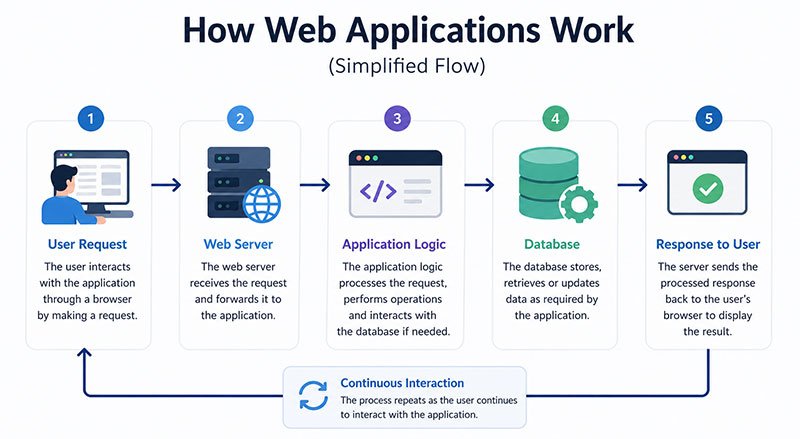
This simplified flow shows how user actions are processed, data is managed, and responses are delivered in real time-forming the backbone of modern web applications.
SaaS Web Applications
SaaS (Software-as-a-Service) applications allow users to access software directly through a browser, eliminating installation and reducing operational complexity.
Key SaaS Characteristics
| Aspect | Description |
|---|---|
| Accessibility | Users can access the application from any device with a browser |
| Revenue Model | Subscription-based pricing enables predictable recurring revenue |
| Infrastructure | Cloud-based hosting ensures scalability and flexibility |
| Maintenance | Continuous updates without user-side installation |
Business Perspective
SaaS applications are ideal for businesses building scalable digital products with recurring revenue models. Many organizations invest in custom web app development to create tailored SaaS solutions.
Enterprise Web Applications
Enterprise web applications are built for organizations that manage complex operations, large data volumes, and multiple users.
Enterprise Application Capabilities
| Capability | Business Benefit |
|---|---|
| System Integration | Connects multiple tools like CRM, ERP, and analytics platforms |
| Scalability | Supports thousands of users and high data loads |
| Security | Ensures data protection and compliance standards |
| Workflow Automation | Improves efficiency and reduces manual effort |
Business Perspective
Enterprise applications centralize operations and enable better decision-making. Businesses often rely on enterprise web development to build robust and scalable systems.
Progressive Web Applications (PWAs)
PWAs provide a mobile-like experience directly through a web browser, combining the benefits of web and mobile platforms.
PWA Benefits Overview
| Feature | Business Impact |
|---|---|
| Offline Access | Users can access the application even without internet connectivity |
| Speed | Faster loading improves user engagement and retention |
| No Installation | Reduces friction and increases user adoption |
| Cross-Platform | Works seamlessly across devices |
Business Perspective
PWAs are an excellent choice for businesses targeting mobile users without investing in separate mobile app development.
Benefits of Web Applications for Businesses
Web applications offer flexibility, scalability, and efficiency, making them essential for businesses operating in a digital-first environment.
- Businesses can access applications from any device without installation, improving accessibility and user convenience.
- Applications can scale easily as the business grows without requiring complete redevelopment.
- Centralized systems reduce operational costs and simplify maintenance and updates.
- Real-time data access enables better decision-making and faster response to market changes.
- Seamless integrations with third-party tools improve efficiency and automate workflows.
Web Application Examples by Industry
Different industries use web applications to solve specific business challenges and improve operational efficiency.
| Industry | Example Use Case |
|---|---|
| Healthcare | Patient portals and telemedicine platforms |
| Finance | Online banking and payment systems |
| eCommerce | Online stores and marketplaces |
| Logistics | Shipment tracking and fleet management systems |
| SaaS | Subscription-based productivity tools |
Choosing the Right Type of Web Application
Selecting the right web application depends on your business goals, user expectations, and growth plans.
Decision Guide
| Business Need | Recommended Web Application Type |
|---|---|
| Simple online presence | Static Web Application |
| Interactive user experience | Dynamic Web Application |
| Scalable digital product | SaaS Application |
| Large-scale operations | Enterprise Application |
| Mobile-first audience | Progressive Web Application |
Making the right choice early helps avoid costly redesigns and ensures your application supports long-term growth. Partnering with experts in web application development services can help align technology decisions with business goals.
Final Thoughts
Understanding different types of web applications allows businesses to choose the right digital strategy. Whether you're building a startup product or scaling enterprise systems, the right approach ensures better performance, user engagement, and ROI.
If you're planning to build or scale a platform, investing in custom web app development ensures your solution is built for long-term success.
Looking for a reliable web app development company to build scalable solutions?
Get expert consultation on strategy, features, timelines, and full development cost breakdown. No pressure, just practical guidance.
FAQs
The main types of web applications include static web applications, dynamic web applications, SaaS applications, enterprise applications, and progressive web applications.
Static applications display fixed content, while dynamic applications provide real-time updates, user interaction, and personalized experiences.
Common web app examples include eCommerce platforms, SaaS tools like CRMs, enterprise dashboards, and booking systems.
A SaaS web application is a cloud-based platform delivered via a browser, typically using a subscription model for recurring revenue.
The best type depends on your goals. SaaS suits scalable products, enterprise apps suit complex operations, and PWAs suit mobile-first audiences.
The cost depends on features, complexity, and scalability. Basic applications start from a few thousand dollars, while enterprise systems require larger investments.
Custom web applications provide flexibility, scalability, and tailored functionality, helping businesses improve efficiency and gain a competitive advantage.