Artificial Intelligence is no longer a “nice-to-have”—it is rapidly becoming the foundation of modern software systems. For businesses using .NET, integrating AI is not just about innovation; it is about staying competitive in a data-driven economy.
However, here’s the reality:
Most companies struggle with AI adoption not because of tools, but because they lack a clear implementation strategy and scalable architecture.
Organizations that overcome this challenge—often by partnering with teams offering AI-powered .NET development services - are building intelligent applications that automate operations, personalize user experiences, and unlock real-time insights at scale.
Quick Answer
Integrating AI into .NET applications involves using tools like ML.NET, Azure AI, and APIs to add automation, predictive analytics, and personalization. This helps businesses improve efficiency, reduce costs, and deliver smarter user experiences.
What AI Integration in .NET Really Means
AI integration in .NET involves embedding intelligent capabilities such as machine learning, natural language processing, and predictive analytics directly into applications.
Instead of static workflows, applications become capable of:
- Continuously learning from user behavior and improving over time
- Making predictions based on historical and real-time data
- Automating complex processes that traditionally required human intervention
- Delivering personalized user experiences across digital touchpoints
👉 Businesses investing in custom .NET development services for AI-driven applications are increasingly building systems that evolve alongside user needs, rather than remaining fixed.
Key Benefits of AI in .NET Applications (With Stats)
| Benefit | Business Impact |
|---|---|
| Process automation | Reduces manual effort by 40–60% |
| Customer support automation | AI chatbots handle 70–80% of queries |
| Predictive analytics | Improves forecasting accuracy by 20–30% |
| Personalization | Drives higher engagement and conversion rates |
👉 These outcomes are why many organizations are expanding beyond traditional development and exploring AI-powered software solutions through their development partners.
AI-Powered .NET Architecture
Modern AI-powered .NET applications typically use a modular architecture that combines APIs, orchestration layers, AI services, and intelligent data retrieval systems. This approach allows businesses to scale AI capabilities efficiently while maintaining application performance and security.
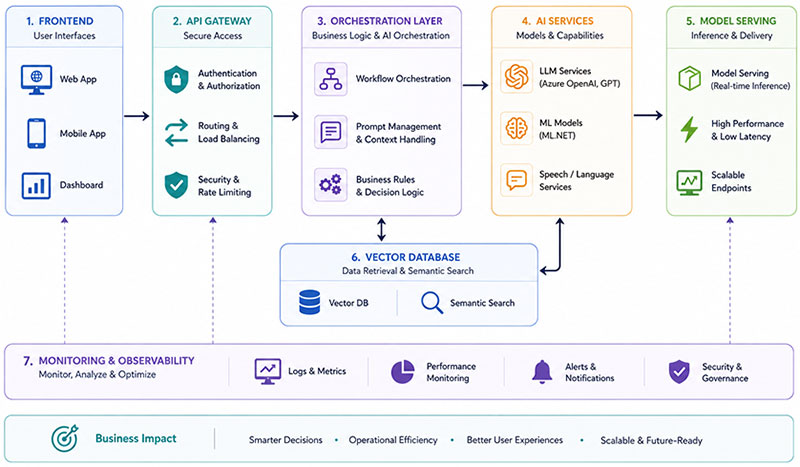
Example architecture for integrating AI capabilities into enterprise-grade .NET applications.
Top Business Opportunities with AI in .NET
1. Intelligent Automation at Scale
AI enables applications to automate not just repetitive tasks, but also decision-driven workflows such as document processing, customer support handling, and backend operations.
This reduces operational costs while improving accuracy and efficiency - making it a key focus area for businesses investing in scalable application development solutions.
2. Predictive Decision-Making
AI transforms historical data into forward-looking insights.
Instead of analyzing past performance alone, businesses can:
- Forecast demand
- Predict customer behavior
- Identify potential risks early
👉 This shift toward predictive intelligence is one of the biggest reasons organizations are adopting AI-enabled .NET development strategies.
3. Hyper-Personalized User Experiences
Modern applications are expected to deliver highly personalized experiences.
AI enables systems to:
- Recommend relevant products or content
- Adapt interfaces based on user preferences
- Optimize user journeys in real time
👉 Businesses looking to improve engagement often integrate these capabilities through custom-built .NET applications tailored for personalization.
4. AI-Powered Chatbots & Virtual Assistants
AI-driven conversational systems allow businesses to provide instant and intelligent support.
These systems:
- Understand user intent through natural language processing
- Provide contextual and accurate responses
- Reduce dependency on manual support teams
👉 Many companies choose to hire .NET developers with AI expertise to build scalable chatbot and assistant solutions.
5. Real-Time Risk Detection & Security
AI can monitor systems continuously and identify anomalies in real time.
This is especially valuable in industries where:
- Fraud detection is critical
- Security threats must be identified instantly
- Compliance requirements are strict
👉 Implementing such systems often requires advanced .NET development capabilities combined with AI integration expertise.
Modern AI Patterns in .NET Applications
Businesses are no longer using AI only for basic automation. Modern .NET applications are increasingly being designed to deliver smarter user experiences, faster decision-making, and more efficient operations through advanced AI capabilities.
Companies investing in AI consulting services are adopting modern AI patterns that help applications become more intelligent, scalable, and adaptable to changing business needs.
1. Retrieval-Augmented Generation (RAG)
Retrieval-Augmented Generation (RAG) helps AI systems generate more accurate and context-aware responses by combining AI models with real-time business data.
This approach is becoming popular for:
- Enterprise knowledge portals
- Customer support systems
- AI-powered search experiences
- Internal documentation assistants
👉 Businesses implementing Generative AI integration services are increasingly using RAG to improve AI accuracy while delivering more reliable and business-specific responses.
2. AI Agents & Intelligent Automation
AI agents go beyond traditional automation by helping systems make decisions, manage workflows, and perform tasks with minimal human involvement.
Businesses are using AI agents for:
- Process automation
- Operational monitoring
- Workflow management
- Customer support handling
👉 Organizations adopting software outsourcing services often integrate AI-driven automation to improve efficiency, reduce costs, and accelerate operations.
3. Copilot-Style User Experiences
Copilot-style AI assistants are rapidly becoming a standard feature in modern business applications. These systems help users complete tasks faster using natural language interactions and intelligent recommendations.
Common examples include:
- AI-powered dashboards
- Smart CRM assistants
- Document summarization tools
- Intelligent workflow suggestions
👉 Businesses building modern applications through cloud solutions services are increasingly adopting AI copilots to improve productivity and user engagement.
4. Vector Databases & Smarter Search Experiences
Modern AI applications need to understand context—not just keywords. Vector databases help applications deliver more intelligent search results, personalized recommendations, and context-aware AI responses.
These capabilities are commonly used in:
- AI chat systems
- Recommendation engines
- Enterprise search platforms
- Personalized user experiences
👉 Companies investing in AI chatbot development services are increasingly using vector-based search to create smarter and more conversational applications.
5. LLM Orchestration & Scalable AI Systems
As AI systems become more advanced, businesses need a reliable way to manage AI models, workflows, and interactions across applications. LLM orchestration helps ensure AI systems remain scalable, efficient, and consistent as usage grows.
This approach helps businesses:
- Scale AI applications more effectively
- Improve AI response quality
- Manage complex workflows
- Optimize long-term AI performance
👉 Businesses implementing enterprise AI solutions through LLM development services and DevOps consulting services are better positioned to build scalable and future-ready AI ecosystems.
As AI adoption continues to grow, these modern AI patterns are helping businesses transform traditional .NET applications into intelligent platforms capable of automation, personalization, and real-time decision-making.
Looking to Integrate AI into Your .NET Applications?
Work with experienced AI and .NET development teams to build scalable, secure, and enterprise-ready intelligent software solutions.
Step-by-Step: How to Integrate AI into .NET Applications
- Identify high-impact use cases, such as automation, analytics, or personalization
- Prepare and structure your data, as AI accuracy depends heavily on data quality
- Select the right tools, including ML.NET or cloud-based AI services
- Integrate AI models into your application using APIs or custom development
- Deploy, monitor, and optimize, ensuring long-term performance and accuracy
👉 Businesses often accelerate this process by working with providers offering AI-focused .NET development services, ensuring faster and more reliable implementation.
Real-World Case Study
Scenario: A fintech company integrated AI into its .NET platform to improve fraud detection.
Challenges:
- Increasing fraudulent transactions
- Slow manual detection processes
- Rising operational costs
Solution:
- Implemented ML-based detection models
- Integrated real-time analytics
- Automated fraud monitoring workflows
Results:
- Improved detection accuracy by 45%
- Reduced response time by 60%
- Significantly lowered financial losses
👉 This demonstrates how businesses leveraging AI-powered .NET solutions can achieve measurable improvements in performance and efficiency.
Recommended Tech Stack for AI in .NET
| Layer | Tools |
|---|---|
| Framework | .NET 6+ |
| AI/ML | ML.NET |
| Cloud | Azure AI |
| Data | SQL Server / NoSQL |
| APIs | REST / GraphQL |
| DevOps | Azure DevOps |
👉 Choosing the right stack—and implementing it correctly—is where experienced teams offering professional .NET development services add significant value.
Challenges & Mistakes to Avoid
1. Focusing on Tools Instead of Data
The biggest mistake businesses make is adopting AI tools without ensuring data quality. Poor data leads to inaccurate insights and unreliable outcomes.
2. Underestimating Integration Complexity
Integrating AI into existing systems requires careful planning, especially when dealing with legacy infrastructure.
3. Expecting Immediate ROI
AI is a long-term investment that delivers value over time through incremental improvements.
4. Ignoring Model Maintenance
AI models require continuous updates to remain accurate as data evolves.
5. Lack of Skilled Expertise
AI integration requires expertise in both software development and data science—something many in-house teams lack.
👉 This is why organizations often partner with providers offering end-to-end .NET development services with AI capabilities.
Final Thoughts
AI is fundamentally changing how applications are built and used. For businesses leveraging .NET, it presents an opportunity to move from traditional systems to intelligent, adaptive platforms.
Companies that invest in AI today are not just improving efficiency—they are building a foundation for long-term growth and innovation.
👉 If you're planning to integrate AI into your applications:
- Explore our .NET development services for scalable solutions
- Hire .NET developers for Integrating AI into .NET Applications
FAQs
Yes, AI can be integrated into existing .NET applications using APIs, ML.NET, or cloud-based AI services without requiring a complete rebuild. This makes it possible for businesses to enhance their current systems incrementally.
A hybrid approach that combines custom machine learning models with cloud-based AI services is typically the most effective. This allows businesses to balance flexibility, scalability, and speed of implementation.
AI enables automation, predictive analytics, personalization, and improved decision-making. These capabilities help businesses operate more efficiently and deliver better user experiences.
While AI requires an initial investment, the long-term return on investment is significant due to improved efficiency, reduced operational costs, and enhanced performance.
Industries such as healthcare, finance, retail, manufacturing, and SaaS benefit the most, as they rely heavily on data-driven insights and automation.