Building successful software products requires more than choosing the right technology—it requires experienced developers who can build scalable, high-performance applications. As businesses invest in SaaS platforms, enterprise software, cloud-native systems, and AI-powered solutions, Node.js has become one of the most popular backend technologies due to its speed, scalability, and real-time capabilities.
However, finding and hiring skilled Node.js developers can be challenging. Competition for experienced backend engineers continues to grow, while traditional recruitment often increases costs and delays project delivery.
As a result, many organizations choose to hire Node.js developers through dedicated engagement models that offer specialized expertise, faster onboarding, and flexible team scaling. Whether you're building a new application or looking for end-to-end Node.js development services, the right team can significantly accelerate product delivery and business growth.
In this guide, we'll cover:
- Why businesses choose Node.js for modern application development
- Benefits of hiring dedicated Node.js developers
- Essential skills to look for
- Popular hiring models and engagement options
- Modern Node.js technology stacks
- Best practices for selecting the right development partner
Whether you're launching an MVP, scaling a SaaS platform, modernizing legacy software, or integrating AI capabilities, this guide will help you make informed hiring decisions.
What is Node.js and Why Businesses Use It
Node.js is an open-source JavaScript runtime environment built on Google's V8 engine that enables developers to execute JavaScript on the server side. Unlike traditional backend technologies that process requests sequentially, Node.js uses an event-driven, non-blocking architecture capable of handling thousands of simultaneous connections efficiently.
This makes Node.js particularly effective for businesses building applications that require speed, scalability, and real-time functionality.
Today, organizations use Node.js to build:
- SaaS applications serving growing customer bases
- Enterprise software platforms
- REST and GraphQL APIs
- Real-time collaboration tools
- Chat and messaging applications
- eCommerce platforms
- Streaming services
- Cloud-native applications
- AI-powered software solutions
Its ability to support both startup-scale and enterprise-scale applications has made Node.js one of the most widely adopted backend technologies globally.
Node.js vs Other Backend Technologies
Before investing in development resources, many businesses evaluate how Node.js compares to alternative backend technologies.
| Technology | Best For | Development Speed | Scalability | Learning Curve |
|---|---|---|---|---|
| Node.js | APIs, SaaS, Real-Time Apps | High | High | Moderate |
| Python | AI & Automation Solutions | High | High | Easy |
| Java | Enterprise Systems | Moderate | Very High | Higher |
| .NET | Enterprise Applications | Moderate | High | Moderate |
| PHP | Traditional Web Applications | Moderate | Moderate | Easy |
While every technology has its strengths, Node.js is particularly attractive for organizations seeking faster development cycles, cloud-native architectures, and highly responsive applications.
Why Businesses Continue to Choose Node.js
Faster Development Cycles
Node.js allows developers to use JavaScript across both frontend and backend development. This unified technology stack improves productivity, simplifies maintenance, and reduces development complexity. Additionally, Node.js benefits from the extensive NPM ecosystem, which provides access to thousands of reusable libraries and packages that accelerate development.
For businesses looking to launch products quickly, this translates into shorter development timelines and faster time-to-market.
Scalability for Growing Applications
Modern software applications must support increasing traffic volumes, expanding feature sets, and growing user bases. Node.js was specifically designed to manage high levels of concurrency efficiently. Its asynchronous architecture allows applications to handle multiple requests simultaneously while consuming fewer server resources.
This scalability makes Node.js particularly well suited for SaaS platforms, enterprise applications, and cloud-based products.
Strong Ecosystem and Community Support
Node.js has one of the largest developer communities in the world. Businesses benefit from extensive documentation, mature frameworks, continuous updates, and a large talent pool. This widespread adoption reduces long-term technology risk and makes it easier to find experienced developers.
Cloud-Native Development Capabilities
Node.js integrates seamlessly with AWS, Azure, and Google Cloud environments, making it an excellent choice for businesses adopting modern cloud architectures.
Organizations frequently combine Node.js development with cloud solutions services and DevOps consulting services to improve scalability, deployment automation, and operational efficiency.
Why Hire Dedicated Node.js Developers
As software projects become increasingly complex, businesses require more than general programming expertise. They need developers who understand application architecture, scalability, cloud infrastructure, API development, and long-term maintainability.
Hiring dedicated Node.js developers provides access to specialized expertise while offering greater flexibility than traditional hiring approaches.
Accelerate Product Development
One of the key benefits of hiring dedicated Node.js developers is faster product delivery. By working exclusively on your project, dedicated developers enable quicker decision-making, better collaboration, and more predictable timelines.
For startups, this can mean launching products ahead of competitors, while enterprises can accelerate digital transformation and reduce development bottlenecks. Many organizations also combine dedicated teams with MVP development services to validate ideas faster, gather early user feedback, and reduce project risk.
Access Specialized Backend Expertise
Modern applications require expertise across multiple technical disciplines.
Experienced Node.js developers typically bring knowledge of:
- API architecture
- Microservices development
- Cloud deployments
- Database optimization
- Security implementation
- Performance tuning
- Scalability planning
This expertise helps businesses avoid costly architectural mistakes and technical debt that can slow growth later.
Scale Teams Faster
Business requirements change constantly. New opportunities emerge, funding rounds close, customer demand increases, and product roadmaps evolve.
Dedicated development teams provide the flexibility to scale resources quickly without lengthy recruitment cycles.
Businesses can add developers, architects, QA engineers, DevOps specialists, or entire dedicated development teams as project requirements grow.
Many organizations choose to hire dedicated developers because it allows them to expand engineering capacity while maintaining flexibility and cost efficiency.
Reduce Operational Costs
Hiring internally involves much more than paying salaries. Additional expenses often include:
- Recruitment and HR costs
- Employee benefits
- Office infrastructure
- Training programs
- Retention initiatives
- Administrative overhead
Dedicated Node.js developers help reduce these operational burdens while still providing access to highly skilled engineering talent.
Typical Node.js Developer Responsibilities
Node.js developers play a critical role in designing, building, and maintaining the backend systems that power modern web and mobile applications. Their responsibilities extend beyond writing code and often include application architecture, database management, API development, cloud deployments, and performance optimization.
Typical responsibilities of a Node.js developer include:
- Designing and developing scalable backend applications
- Building RESTful APIs and GraphQL APIs
- Creating microservices-based architectures
- Integrating third-party services and external APIs
- Managing databases such as MongoDB, PostgreSQL, and MySQL
- Implementing authentication and authorization mechanisms
- Optimizing application performance and scalability
- Writing clean, maintainable, and well-documented code
- Collaborating with frontend developers, QA teams, and DevOps engineers
- Deploying and maintaining applications in cloud environments
- Monitoring system performance and troubleshooting issues
- Implementing security best practices and compliance requirements
As applications grow in complexity, senior Node.js developers may also participate in system architecture decisions, technology selection, infrastructure planning, and mentoring junior developers.
Businesses looking to build scalable SaaS platforms, enterprise applications, or cloud-native systems should ensure that Node.js developers possess both strong coding skills and a solid understanding of modern software architecture principles.
Key Skills Every Node.js Developer Should Have
Hiring the right Node.js developer requires evaluating more than coding ability. Businesses should assess a combination of backend expertise, architectural thinking, cloud knowledge, DevOps familiarity, and problem-solving skills.
The ideal skill set will vary depending on project complexity, but several competencies remain essential across most Node.js development initiatives.
Strong Node.js Development Expertise
Every Node.js developer should possess a strong understanding of:
- Node.js fundamentals
- Express.js
- NestJS
- TypeScript
- REST APIs
- GraphQL
- Authentication mechanisms
- Middleware architecture
- Asynchronous programming
Developers should be capable of building scalable, maintainable applications rather than simply delivering functional code.
Database Design and Optimization
Backend performance is heavily influenced by database architecture.Node.js developers should have practical experience with:
- MongoDB
- PostgreSQL
- MySQL
- Redis
- Query optimization
- Database indexing
- Data modeling
Strong database expertise helps ensure applications remain responsive as usage grows.
Cloud and Infrastructure Skills
Modern applications increasingly rely on cloud-native infrastructure. Experienced developers should understand:
- AWS
- Azure
- Google Cloud Platform
- Serverless computing
- Containerized deployments
- Cloud security best practices
Many businesses combine backend development with cloud solutions services to improve scalability, availability, and operational efficiency.
DevOps and Deployment Knowledge
Today's development teams are expected to collaborate closely with infrastructure and operations teams.Node.js developers should be familiar with:
- Docker
- Kubernetes
- CI/CD pipelines
- GitHub Actions
- Jenkins
- Monitoring tools
DevOps practices help organizations improve deployment speed, reliability, and operational efficiency, making DevOps consulting services a valuable complement to modern application development.
Recommended Team Structure by Project Type
The ideal team structure depends on the size, complexity, and goals of your project. While smaller projects may only require one developer, larger applications often benefit from a cross-functional team that includes designers, QA engineers, and DevOps specialists.
Recommended Team Composition
| Project Type | Recommended Team Structure |
|---|---|
| MVP / Proof of Concept | 1 Node.js Developer, 1 Frontend Developer, 1 UI/UX Designer |
| Startup SaaS Product | 2-3 Node.js Developers, 1 Frontend Developer, 1 QA Engineer |
| Mid-Size Business Application | 3-5 Developers, 1 QA Engineer, 1 Project Manager |
| Enterprise Platform | 5-10 Developers, QA Team, DevOps Engineer, Project Manager |
| AI-Powered Application | Node.js Developers, AI Engineers, QA Engineer, DevOps Engineer |
| Cloud Migration Project | Node.js Developers, Cloud Architect, DevOps Engineer |
Typical Node.js Team Growth Path as Products Scale
| MVP Stage | Growth Stage | Scale Stage |
|---|---|---|
| Backend Developer | 2-3 Backend Developers | Dedicated Development Team |
| Frontend Developer | QA Engineer | DevOps Engineer |
| UI/UX Designer | Project Manager | |
| Technical Architect |
Choosing the right team size helps control costs while ensuring sufficient resources are available to meet project goals and delivery timelines.
Understanding the Modern Node.js Technology Stack
Modern application development requires expertise across multiple technologies that work together to deliver secure, scalable, and high-performance software solutions.
Businesses evaluating Node.js developers should understand the broader ecosystem surrounding modern application development.
Typical Node.js Technology Stack
| Layer | Technologies Commonly Used |
|---|---|
| Frontend | React, Vue.js, Angular |
| Backend | Node.js, Express.js, NestJS |
| APIs | REST, GraphQL |
| Databases | MongoDB, PostgreSQL, MySQL |
| Cache Layer | Redis |
| Cloud Platforms | AWS, Azure, Google Cloud |
| DevOps | Docker, Kubernetes, GitHub Actions |
Developers who understand how these technologies interact can build more scalable, maintainable, and future-ready applications.
Typical Node.js Application Architecture
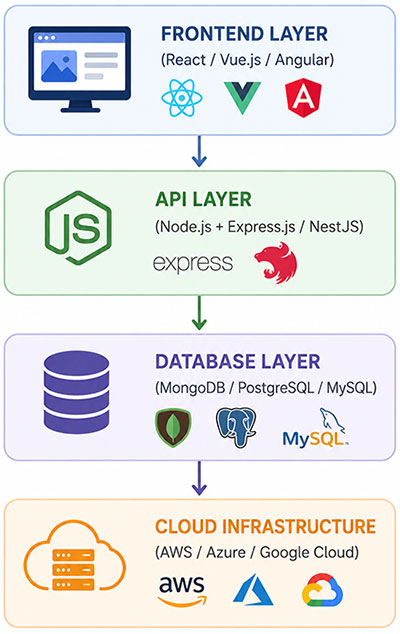
Why Full-Stack Awareness Matters
Even if a developer focuses primarily on backend engineering, understanding frontend technologies, cloud infrastructure, databases, and deployment workflows significantly improves project outcomes.
Businesses modernizing older systems often use Node.js as part of broader legacy software modernization services initiatives that improve scalability and long-term maintainability.
Developers with broader ecosystem knowledge are often better equipped to contribute to architectural decisions and collaborate across multiple technical disciplines.
Node.js Hiring Models Compared
Choosing the right hiring model can significantly impact project costs, scalability, delivery timelines, and long-term success.
Different business goals require different engagement approaches.
Dedicated Node.js Developers
Dedicated developers work exclusively on your project and function as an extension of your internal team.
Businesses that choose to hire dedicated developers benefit from:
- Strong collaboration
- Better project continuity
- Greater development control
- Faster knowledge retention
- Flexible team scaling
This model is particularly effective for SaaS platforms, enterprise applications, and long-term software initiatives.
Team Augmentation
Team augmentation enables businesses to add external Node.js developers to existing internal teams.
This model works well when organizations need:
- Additional development capacity
- Specialized expertise
- Faster project execution
- Temporary team expansion
Developers integrate directly into existing workflows and processes.
Project-Based Outsourcing
Project-based outsourcing involves partnering with a specialized development company that assumes responsibility for delivering a complete solution based on predefined requirements.
Many businesses leverage software outsourcing services when they want to accelerate delivery while minimizing management overhead.
This approach is commonly used for:
- MVP development
- Fixed-scope projects
- Smaller applications
- Short-term initiatives
Hiring Model Comparison
| Hiring Model | Best For | Flexibility | Control |
|---|---|---|---|
| Dedicated Developers | Long-Term Projects | High | High |
| Team Augmentation | Team Expansion | High | High |
| Project Outsourcing | Fixed Scope Projects | Moderate | Moderate |
Freelancer vs Dedicated Developer vs Development Agency
Businesses evaluating Node.js development options often compare freelancers, dedicated developers, and full-service agencies.
| Factor | Freelancer | Dedicated Developer | Development Agency |
|---|---|---|---|
| Cost | Lowest | Moderate | Higher |
| Scalability | Limited | High | Very High |
| Reliability | Moderate | High | High |
| Project Continuity | Moderate | High | Very High |
| Team Expansion | Difficult | Easy | Very Easy |
| Long-Term Support | Limited | Strong | Strong |
Which Model Is Best?
Freelancers may be suitable for small projects with limited complexity.
Dedicated Node.js developers are often the best choice for businesses requiring ongoing development support, close collaboration, and flexible team scaling.
Development agencies typically provide the broadest capabilities, including project management, UI/UX design, quality assurance, cloud expertise, DevOps support, AI integration, and long-term maintenance services.
Offshore vs In-House Node.js Developers
One of the most important decisions businesses face when building a development team is whether to hire in-house developers or work with offshore Node.js developers. Both approaches have advantages, and the right choice depends on project requirements, budget, timeline, and scalability needs.
In-house developers offer direct oversight and may be better aligned with company culture. However, recruiting, onboarding, and retaining experienced Node.js talent can be expensive and time-consuming, particularly in competitive markets.
Offshore Node.js developers provide access to a global talent pool, enabling businesses to hire experienced engineers faster while reducing development costs. This model also offers greater flexibility when scaling teams up or down as project requirements evolve.
Offshore vs In-House Comparison
| Factor | Offshore Developers | In-House Developers |
|---|---|---|
| Hiring Speed | Faster | Slower |
| Development Cost | Lower | Higher |
| Talent Availability | Global Pool | Local Market |
| Scalability | High | Moderate |
| Infrastructure Costs | Lower | Higher |
| Administrative Overhead | Lower | Higher |
| Team Expansion | Easy | Slower |
Many businesses choose to hire dedicated Node.js developers offshore because it combines cost efficiency, flexibility, and access to specialized expertise without the long-term commitments associated with traditional hiring.
Cost to Hire Node.js Developers in 2026
The cost of hiring Node.js developers varies depending on factors such as developer experience, geographic location, project complexity, and engagement model. Businesses should evaluate cost alongside expertise, communication skills, and long-term value rather than focusing solely on hourly rates.
Node.js Developer Rates by Region (2026)
| Region | Hourly Rate | Approx. Monthly Cost (Full-Time) |
|---|---|---|
| India | $20 – $45 | $3,000 – $7,000 |
| Eastern Europe | $40 – $80 | $6,000 – $12,000 |
| Western Europe | $70 – $130 | $10,000 – $20,000 |
| North America | $80 – $150+ | $12,000 – $25,000+ |
India continues to be one of the most cost-effective destinations for hiring dedicated Node.js developers, offering a strong balance of technical expertise, communication skills, and competitive pricing. However, actual costs may vary based on developer experience, project complexity, cloud expertise, and engagement model.
Cost by Experience Level
| Experience Level | Hourly Rate | Monthly Cost |
|---|---|---|
| Junior Developer | $20 – $30 | $3,000 – $4,500 |
| Mid-Level Developer | $30 – $45 | $4,500 – $7,000 |
| Senior Developer | $45 – $70 | $7,000 – $11,000 |
| Node.js Architect | $70 – $100+ | $11,000 – $16,000+ |
Factors That Influence Cost
Several variables can impact Node.js development costs:
- Developer experience and seniority
- Application complexity
- Cloud and DevOps requirements
- Industry-specific expertise
- Team size
- Contract duration
- Security and compliance requirements
While senior developers command higher rates, their ability to design scalable architectures and avoid costly mistakes often delivers greater long-term value.
How to Hire Node.js Developers (Step-by-Step)
Hiring the right Node.js developers requires a structured approach that balances technical expertise, business requirements, and long-term scalability.
Step 1: Define Project Requirements
Begin by clearly defining:
- Project objectives
- Technical requirements
- Budget expectations
- Development timeline
- Team size requirements
Well-defined requirements improve hiring accuracy and reduce project risks.
Step 2: Choose the Right Engagement Model
Select the hiring model that best aligns with your business goals.
Options typically include:
- Dedicated Developers
- Team Augmentation
- Project-Based Outsourcing
The ideal model depends on project scope, flexibility requirements, and internal technical capabilities.
Step 3: Evaluate Technical Expertise
Assess candidates based on:
- Node.js proficiency
- API development experience
- Database knowledge
- Cloud expertise
- System design capabilities
- Problem-solving skills
Reviewing previous projects and conducting technical assessments can help identify the most qualified developers.
Step 4: Assess Communication and Collaboration Skills
Successful software development requires effective communication and collaboration.
Evaluate:
- Communication abilities
- Responsiveness
- Agile experience
- Documentation practices
- Team collaboration skills
These factors become especially important when working with distributed teams
Step 5: Start with a Pilot Engagement
Before committing to a long-term engagement, consider starting with a smaller pilot project.
This allows businesses to evaluate:
- Code quality
- Delivery speed
- Collaboration effectiveness
- Technical capabilities
A pilot engagement helps reduce hiring risk and establish confidence before scaling the team.
Node.js Developer Interview Questions
Evaluating technical expertise is one of the most important parts of the hiring process. The following questions can help businesses assess both foundational knowledge and practical experience.
Technical Questions
- What is Node.js and how does it differ from traditional backend technologies?
- How does the Node.js event loop work?
- What is asynchronous programming, and why is it important in Node.js?
- What are Promises and Async/Await?
- How would you improve the performance of a Node.js application?
- What is the difference between Express.js and NestJS?
- How do you handle error management in Node.js applications?
- What strategies do you use to secure APIs?
- How do you design scalable microservices architectures?
- What databases have you worked with and why did you choose them?
Practical and Architectural Questions
- Describe a challenging Node.js project you worked on.
- How would you handle sudden traffic spikes in a SaaS application?
- What monitoring and logging tools have you used?
- How do you approach application testing and quality assurance?
- What cloud platforms and deployment strategies have you worked with?
These questions help identify developers who can contribute not only at the coding level but also at the architecture and business-solution level.
Common Hiring Mistakes to Avoid
Even experienced organizations can make costly hiring mistakes when evaluating Node.js developers. Understanding these pitfalls can improve hiring outcomes and reduce project risk.
Prioritizing Cost Over Quality
Selecting developers based solely on the lowest rate often leads to poor code quality, technical debt, and higher long-term costs. Businesses should evaluate expertise, communication, and problem-solving capabilities alongside pricing.
Ignoring Architecture Experience
Many developers can write code, but fewer possess experience designing scalable and maintainable systems. Architecture decisions made early in a project can significantly impact future performance and scalability.
Overlooking Cloud and DevOps Skills
Modern applications increasingly rely on cloud-native infrastructure and automated deployment pipelines. Developers with cloud and DevOps expertise can often deliver more reliable and scalable solutions.
Failing to Validate Technical Skills
Resumes and portfolios provide useful information, but practical assessments often reveal a candidate's true capabilities. Technical interviews, coding assessments, and project reviews should be part of every hiring process.
Unclear Project Requirements
Poorly defined requirements frequently result in scope creep, missed deadlines, and budget overruns. Investing time in planning before hiring improves project success and reduces delivery risks.
Cybermax Solutions helps startups, SMBs, and enterprises build scalable software products through experienced Node.js developers, dedicated development teams, and flexible engagement models.
Whether you're launching a new SaaS platform, modernizing legacy systems, or scaling an existing application, our team provides the expertise needed to accelerate development and achieve business goals.
Experienced Node.js Developers
Our developers have hands-on experience building:
- SaaS platforms
- Enterprise applications
- APIs and microservices
- Cloud-native systems
- AI-powered applications
Flexible Hiring Models
Choose the engagement model that best fits your needs:
- Dedicated Node.js Developers
- Team Augmentation
- Software Outsourcing
- End-to-End Product Development
AI-Assisted Development Workflow
We leverage modern AI-powered tools to improve development efficiency, reduce repetitive tasks, enhance code quality, and accelerate delivery timelines.
Cloud and DevOps Expertise
Our team combines application development with cloud architecture and DevOps best practices to deliver secure, scalable, and high-performing solutions.
Fast Team Onboarding
Quick access to experienced developers enables businesses to reduce hiring delays and accelerate project execution.
Looking to Build or Scale Your Node.js Team?
Whether you need a single developer or an entire dedicated team, Cybermax Solutions can help you hire skilled Node.js developers aligned with your technical and business requirements.
FAQs
Node.js developers help businesses build scalable, high-performance applications, APIs, SaaS platforms, and real-time systems while accelerating development timelines.
Depending on experience and location, Node.js developer rates typically range from $20 to $150+ per hour.
Key skills include Node.js, Express.js, TypeScript, API development, database management, cloud platforms, DevOps practices, and system design.
Offshore developers provide access to global talent, lower development costs, faster hiring, and greater scalability compared to traditional hiring models.
Dedicated developers are often ideal for long-term projects, while team augmentation and project outsourcing work well for shorter-term or specialized requirements.
Yes. Node.js is widely used for enterprise-grade applications, microservices architectures, APIs, SaaS platforms, and high-traffic systems.
Depending on project requirements and availability, dedicated Node.js developers can often be onboarded within one to two weeks.
Yes. Node.js is frequently used as the backend layer for AI-powered applications, chatbots, automation platforms, and solutions that integrate large language models (LLMs) and generative AI technologies.
Conclusion
Hiring React developers is a strategic decision that directly impacts your product’s success. By understanding cost structures, choosing the right hiring model, and following best practices, you can build a strong team that delivers long-term value.